
The ZIMBABWE Kingdom
The Kingdom of Zimbabwe (c. 1220–1450) was a medieval Shona (Karanga) kingdom located in modern-day Zimbabwe. Its capital, today’s Masvingo (meaning fortified), which is commonly called Great Zimbabwe, is the largest stone structure in precolonial Southern Africa. This kingdom came about after the collapse of the Kingdom of Mapungubwe.
The name “Zimbabwe” stems from a Shona term for Great Zimbabwe, a medieval city in the country’s south-east whose remains are now a protected site. Two different theories address the origin of the word. Many sources hold that “Zimbabwe” derives from dzimba-dza-mabwe, translated from the Karanga dialect of Shona as “houses of stones” (dzimba = plural of imba, “house”; mabwe = plural of bwe, “stone”).[1][2][3] The Kalanga-speaking Shona people live around Great Zimbabwe in the modern-day province of Masvingo. Archaeologist Peter Garlake claims that “Zimbabwe” represents a contracted form of dzimba-hwe, which means “venerated houses” in the Zezuru dialect of Shona and usually references chiefs’ houses or graves.[4]
Introduction
General Information

Origin
Great Zimbabwe was a city-state located in what is now Zimbabwe that flourished between the 11th and 15th centuries. It was a major center of trade, connecting the interior of southern Africa with the coastal regions and the Indian Ocean rim countries. Great Zimbabwe was involved in a thriving trade network that exchanged goods such as gold, ivory, iron, and textiles with these countries. Arab, Portuguese, and Chinese traders all played a role in the trade that passed through Great Zimbabwe and its network of outposts, contributing to its prosperity and cultural diversity. The trade relationships established by Great Zimbabwe helped to shape the development of southern Africa, and its legacy continues to be felt today.
Although the Kingdom of Zimbabwe was formally established during the medieval period, archaeological excavations in the region suggest that state formation here was considerably more ancient. Earlier theories suggested that in the early 11th century, people from the Kingdom of Mapungubwe in Southern Africa moved north into the Great Zimbabwe area. Newer research and evidence shows that the Great Zimbabwe site had been occupied as early as 600 AD and that the city and Kingdom were an evolution of the Gumanye and Gokomere cultures, some of which are still in existence today.
Rise of Mutapa
Dating since atleast the 15th century, the Mutapa state had once controlled the expanse of territory between the rivers Zambezi, Mazowe, Ruenya, Hunyani and the Umvukwe Range.[5]
In approximately 1430, Prince Nyatsimba Mutota from the Great Zimbabwe travelled north to the Dande region in search of salt. He then defeated the Tonga and Tavara with his army and established his dynasty at Chitakochangonya Hill. The land he conquered would become the Kingdom of Mutapa. Within a generation, Mutapa eclipsed Great Zimbabwe as the economic and political power in Zimbabwe. By 1450, the capital and most of the kingdom had been abandoned.
D.N. Beach in 2014 argued that “Because of the reluctance or inability of many researchers to work in Rhodesia and Mozambique in the last 15 years, the history of the Mutapa state has been heavily dependent upon the work of D.P. Abraham, at least as far as traditions are concerned.”[5]
Aftermath
The end of the kingdom resulted in a fragmenting of proto-Shona power. Two bases emerged along a north–south axis. In the north, the Kingdom of Mutapa carried on and even improved upon Zimbabwe’s administrative structure. It did not carry on the stone-masonry tradition to the extent of its predecessor. In the south, the Kingdom of Butua was established as a smaller, but nearly identical, version of Zimbabwe. Both states were eventually absorbed into the largest and most powerful of the Shona states, the Rozwi Empire.
great zimbabwe

History of the Zimbabwe King- and Queendoms
 |
||||||||||
|
|
||||||||||
|
Great Zimbabwe is a medieval city in the south-eastern hills of Zimbabwe near Lake Mutirikwi and the town of Masvingo. It is thought to have been the capital of a great kingdom during the country’s Late Iron Age about which little is known.[1] Construction on the city began in the 9th century and continued until it was abandoned in the 15th century.[2][3] The edifices are believed to have been erected by the ancestral Shona.[4] The stone city spans an area of 7.22 square kilometres (2.79 square miles) and could have housed up to 18,000 people at its peak, giving it a population density of approximately 2,500 per square kilometre. It is recognised as a World Heritage Site by UNESCO.
Great Zimbabwe is believed to have served as a royal palace for the local monarch. As such, it would have been used as the seat of political power. Among the edifice’s most prominent features were its walls, some of which are eleven metres high.[4] They were constructed without mortar (dry stone). Eventually, the city was abandoned and fell into ruin.
The earliest document mentioning the Great Zimbabwe ruins was in 1531 by Vicente Pegado, captain of the Portuguese garrison of Sofala on the coast of modern-day Mozambique, who recorded it as Symbaoe. The first confirmed visits by Europeans were in the late 19th century, with investigations of the site starting in 1871.[5] Some later studies of the monument were controversial, as the white government of Rhodesia pressured archaeologists to deny its construction by black Africans.[6] Great Zimbabwe has since been adopted as a national monument by the Zimbabwean government, and the modern independent state was named after it.
The word great distinguishes the site from the many smaller ruins, now known as “zimbabwes”, spread across the Zimbabwe Highveld.[7] There are 200 such sites in southern Africa, such as Bumbusi in Zimbabwe and Manyikeni in Mozambique, with monumental, mortarless walls.[8]
Name Great Zimbabwe
Zimbabwe is the Shona name of the ruins, first recorded in 1531 by Vicente Pegado, captain of the Portuguese garrison of Sofala. Pegado noted that “The natives of the country call these edifices Symbaoe, which according to their language signifies ‘court‘“.[9]
The name contains dzimba, the Shona term for “houses”. There are two theories for the etymology of the name. The first proposes that the word is derived from Dzimba-dza-mabwe, translated from Shona as “large houses of stone” (dzimba = plural of imba, “house”; mabwe = plural of bwe, “stone”).[10] A second suggests that Zimbabwe is a contracted form of dzimba-hwe, which means “venerated houses” in the Zezuru dialect of Shona, as usually applied to the houses or graves of chiefs.[11]
Settlement
The majority of scholars believe that it was built by members of the Gokomere culture, who were the ancestors of the modern Shona in Zimbabwe.
The Great Zimbabwe area was settled by the 4th century AD. Between the 4th and the 7th centuries, communities of the Gokomere or Ziwa cultures farmed the valley, and mined and worked iron, but built no stone structures.[8][12] These are the earliest Iron Age settlements in the area identified from archaeological diggings.[13]
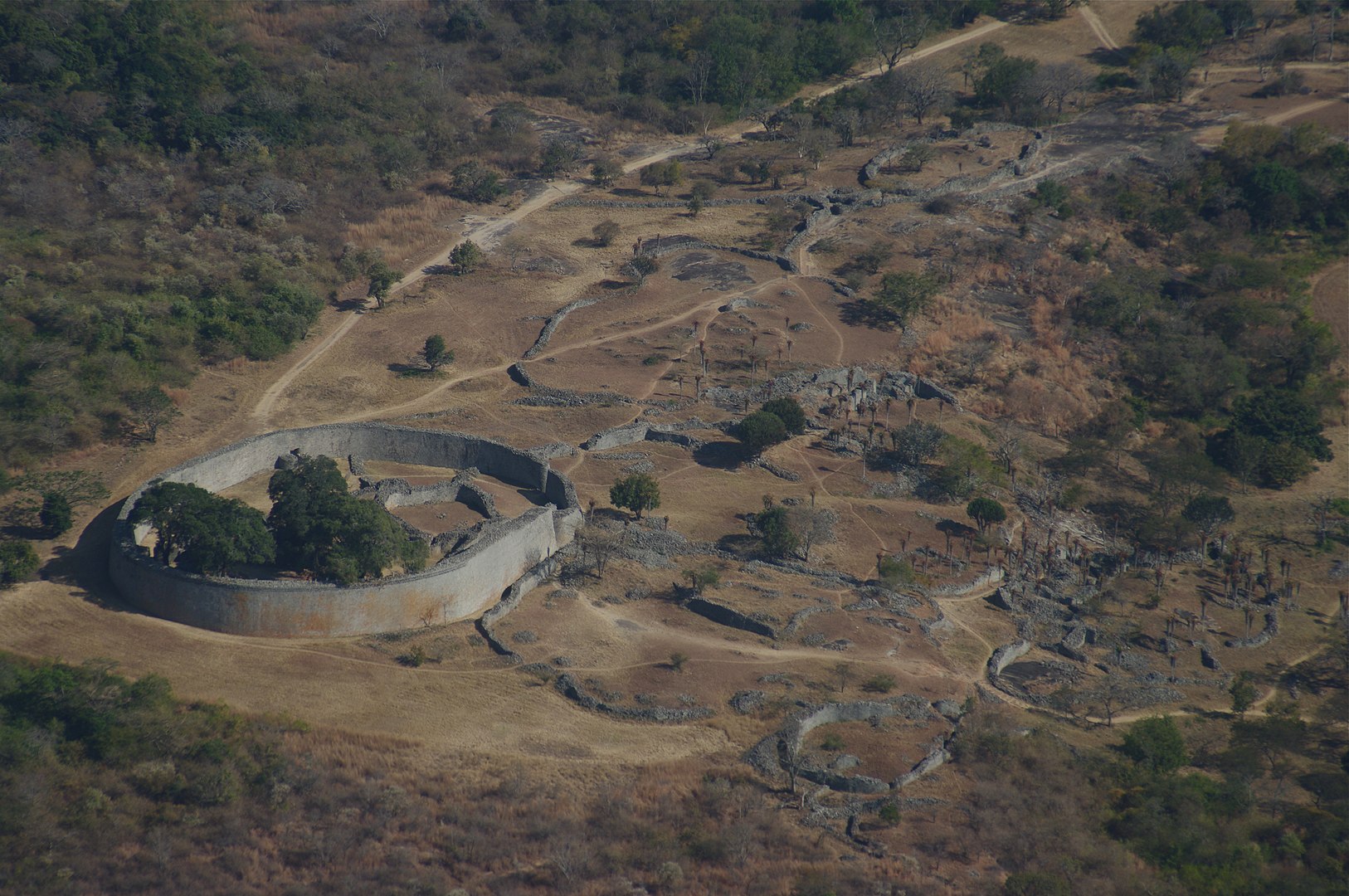
Aerial view of Great Enclosure and Valley Complex, looking west

Detail of the wall with lichen, 1975
Aart Rietveld collection
Construction & Growth
Construction of the stone buildings started in the 11th century and continued for over 300 years.[3] The ruins at Great Zimbabwe are some of the oldest and largest structures located in Southern Africa, and are the second oldest after nearby Mapungubwe in South Africa. Its most formidable edifice, commonly referred to as the Great Enclosure, has walls as high as 11 m (36 ft) extending approximately 250 m (820 ft). David Beach believes that the city and its proposed state, the Kingdom of Zimbabwe, flourished from 1200 to 1500,[2] although a somewhat earlier date for its demise is implied by a description transmitted in the early 1500s to João de Barros.[14] Its growth has been linked to the decline of Mapungubwe from around 1300, due to climatic change[15] or the greater availability of gold in the hinterland of Great Zimbabwe.[16]
Traditional estimates are that Great Zimbabwe had as many as 18,000 inhabitants at its peak.[17] However, a more recent survey concluded that the population likely never exceeded 10,000.[18] The ruins that survive are built entirely of stone; they span 730 ha (1,800 acres).
Features of the Monument
In 1531, Vicente Pegado, Captain of the Portuguese Garrison of Sofala, described Zimbabwe thus:[9]
Among the gold mines of the inland plains between the Limpopo and Zambezi rivers there is a fortress built of stones of marvelous size, and there appears to be no mortar joining them … This edifice is almost surrounded by hills, upon which are others resembling it in the fashioning of stone and the absence of mortar, and one of them is a tower more than 12 fathoms [22 m] high. The natives of the country call these edifices Symbaoe, which according to their language signifies court.
— Vicente Pegado
The ruins form three distinct architectural groups. They are known as the Hill Complex, the Valley Complex and the Great Enclosure. The Hill Complex is the oldest, and was occupied from the 9th to 13th centuries. The Great Enclosure was occupied from the 13th to 15th centuries, and the Valley Complex from the 14th to 16th centuries.[8] Notable features of the Hill Complex include the Eastern Enclosure, in which it is thought the Zimbabwe Birds stood, a high balcony enclosure overlooking the Eastern Enclosure, and a huge boulder in a shape similar to that of the Zimbabwe Bird.[19] The Great Enclosure is composed of an inner wall, encircling a series of structures and a younger outer wall. The Conical Tower, 5.5 m (18 ft) in diameter and 9 m (30 ft) high, was constructed between the two walls.[20] The Valley Complex is divided into the Upper and Lower Valley Ruins, with different periods of occupation.[8]
There are different archaeological interpretations of these groupings. It has been suggested that the complexes represent the work of successive kings: some of the new rulers founded a new residence.[2] The focus of power moved from the Hill Complex in the 12th century, to the Great Enclosure, the Upper Valley and finally the Lower Valley in the early 16th century.[8] The alternative “structuralist” interpretation holds that the different complexes had different functions: the Hill Complex as a temple, the Valley complex was for the citizens, and the Great Enclosure was used by the king. Structures that were more elaborate were probably built for the kings, although it has been argued that the dating of finds in the complexes does not support this interpretation.[21]
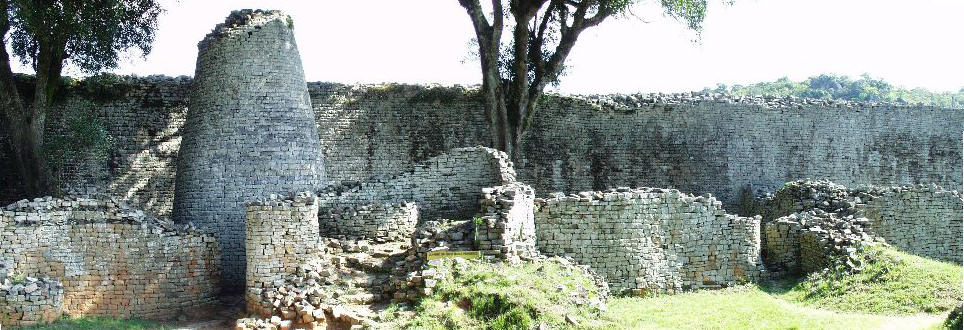
The conical tower inside the Great Enclosure at Great Zimbabwe
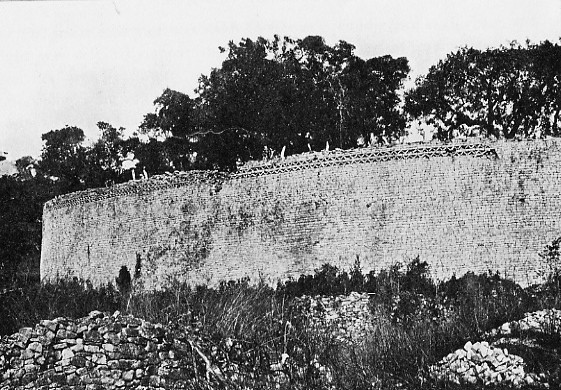
Exterior wall of the Great Enclosure. Picture taken by David Randall-MacIver in 1906.
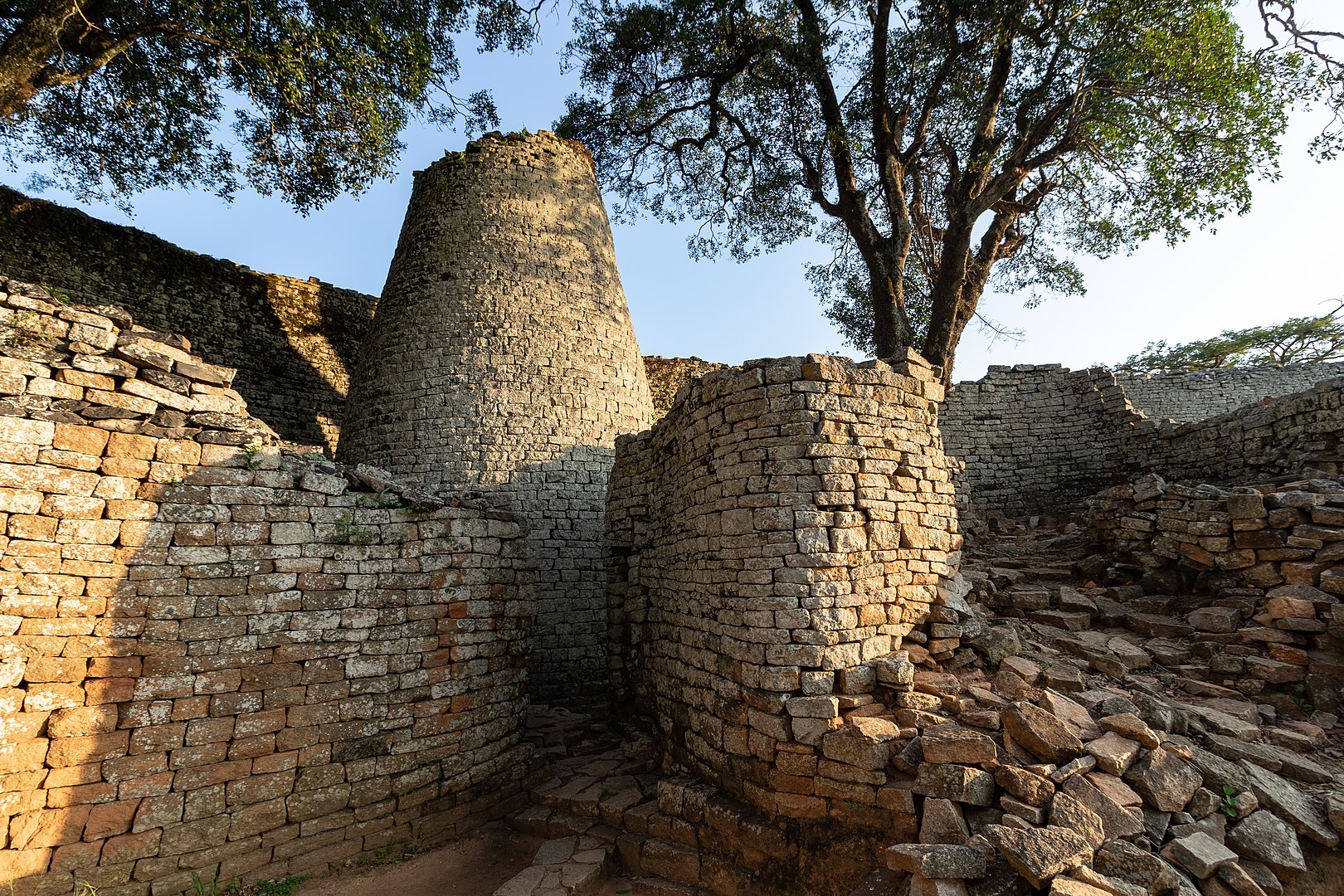
By Andrew Moore from Johannesburg, South Africa – Conical Tower – Great Enclosure III, CC BY-SA 2.0,
Notable Artefacts
The most important artefacts recovered from the Monument are the eight Zimbabwe Birds. These were carved from a micaceous schist (soapstone) on the tops of monoliths the height of a person.[22] Slots in a platform in the Eastern Enclosure of the Hill Complex appear designed to hold the monoliths with the Zimbabwe birds, but as they were not found in situ it cannot be determined which monolith and bird were where.[23] Other artefacts include soapstone figurines (one of which is in the British Museum[24]), pottery, iron gongs, elaborately worked ivory, iron and copper wire, iron hoes, bronze spearheads, copper ingots and crucibles, and gold beads, bracelets, pendants and sheaths.[25][26] Glass beads and porcelain from China and Persia[27] among other foreign artefacts were also found, attesting the international trade linkages of the Kingdom. In the extensive stone ruins of the great city, which still remain today, include eight, monolithic birds carved in soapstone. It is thought that they represent the bateleur eagle – a good omen, protective spirit and messenger of the gods in Shona culture.[28]

Copy of Zimbabwe Bird soapstone sculpture
By J. Patrick Fischer

Great Zimbabwe Birds, painted by Shiri Hungwe, 2013, Charcoal on book paper
Ancient Trade
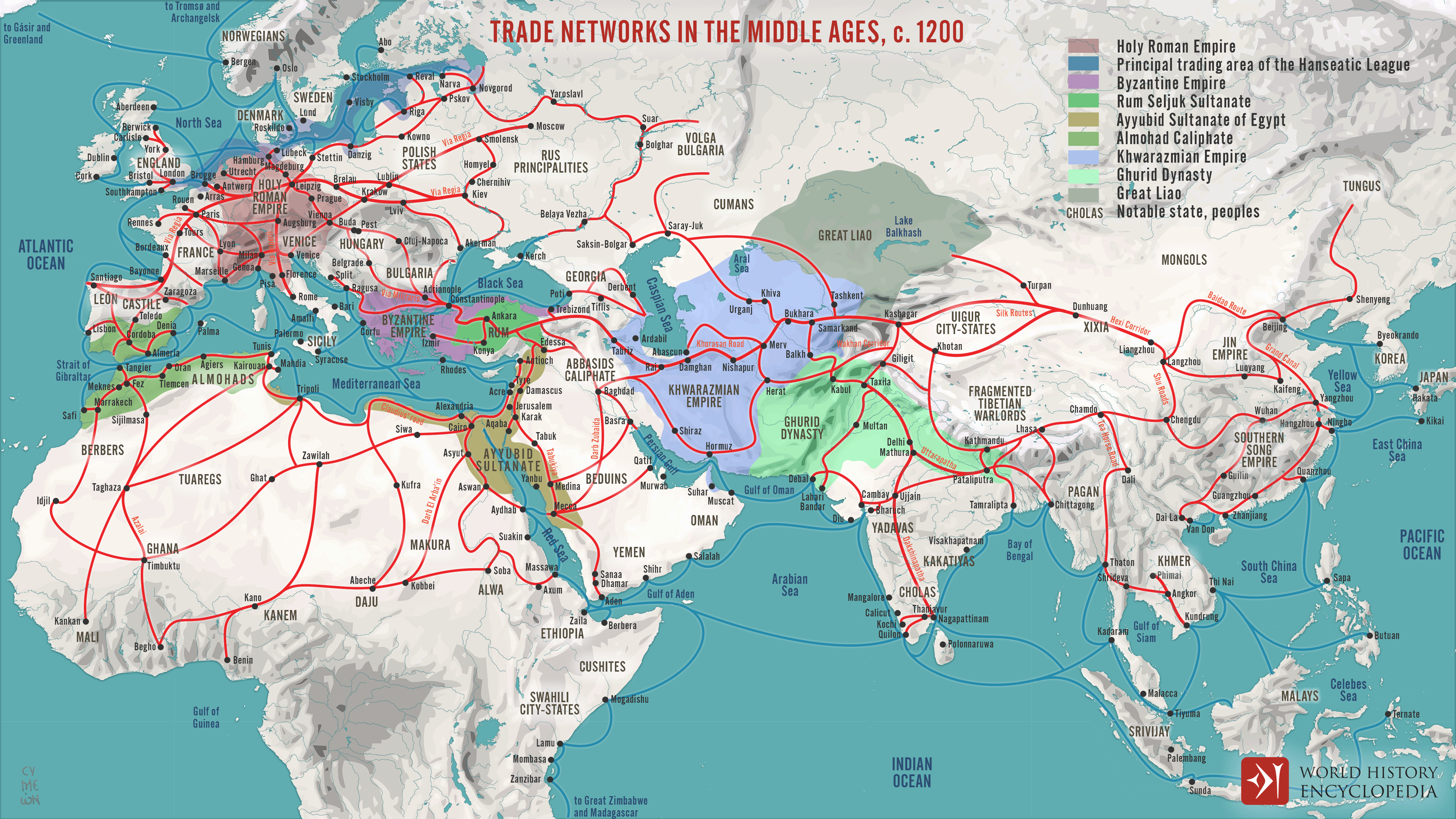
Archaeological evidence suggests that Great Zimbabwe became a centre for trading, with artefacts[29] suggesting that the city formed part of a trade network linked to Kilwa[30] and extending as far as China. Copper coins found at Kilwa Kisiwani appear to be of the same pure ore found on the Swahili coast.[31] This international trade was mainly in gold and ivory; some estimates indicate that more than 20 million ounces of gold were extracted from the ground.[32] That international commerce was in addition to the local agricultural trade, in which cattle were especially important.[16] The large cattle herd that supplied the city moved seasonally and was managed by the court.[22] Chinese pottery shards, coins from Arabia, glass beads and other non-local items have been excavated at Zimbabwe. Despite these strong international trade links, there is no evidence to suggest exchange of architectural concepts between Great Zimbabwe and centres such as Kilwa.[33]
Decline
The causes for the decline and ultimate abandonment of the site around 1450 have been suggested as due to a decline in trade compared to sites further north, the exhaustion of the gold mines, political instability and famine and water shortages induced by climatic change.[16][34] The Mutapa state arose in the 15th century from the northward expansion of the Great Zimbabwe tradition,[35] having been founded by Nyatsimba Mutota from Great Zimbabwe after he was sent to find new sources of salt in the north;[36] (this supports the belief that Great Zimbabwe’s decline was due to a shortage of resources). Great Zimbabwe also predates the Khami and Nyanga cultures.[37]

research and origin
From Portuguese Traders to Alexander Merensky and Karl Mauch
The first European visit may have been made by the Portuguese traveler António Fernandes in 1513–1515, who crossed twice and reported in detail the region of present-day Zimbabwe (including the Shona kingdoms) and also fortified centers in stone without mortar. However, passing en route a few kilometres north and about 56 km (35 mi) south of the site, he did not make a reference to Great Zimbabwe.[38][39] Portuguese traders heard about the remains of the medieval city in the early 16th century, and records survive of interviews and notes made by some of them, linking Great Zimbabwe to gold production and long-distance trade.[40] Two of those accounts mention an inscription above the entrance to Great Zimbabwe, written in characters not known to the Arab merchants who had seen it.[14][41]
In 1506, the explorer Diogo de Alcáçova described the edifices in a letter to the then King of Portugal, writing that they were part of the larger kingdom of Ucalanga (presumably Karanga, a dialect of the Shona people spoken mainly in Masvingo and Midlands provinces of Zimbabwe).[42] João de Barros left another such description of Great Zimbabwe in 1538, as recounted to him by Moorish traders who had visited the area and possessed knowledge of the hinterland. He indicates that the edifices were locally known as Symbaoe, which meant “royal court” in the vernacular.[43] As to the actual identity of the builders of Great Zimbabwe, de Barros writes:[44]
When and by whom, these edifices were raised, as the people of the land are ignorant of the art of writing, there is no record, but they say they are the work of the devil,[45] for in comparison with their power and knowledge it does not seem possible to them that they should be the work of man.
— João de Barros
Additionally, with regard to the purpose of the Great Zimbabwe ruins, de Barros asserted that: “in the opinion of the Moors who saw it [Great Zimbabwe] it is very ancient and was built to keep possessions of the mines, which are very old, and no gold has been extracted from them for years, because of the wars … it would seem that some prince who has possession of these mines ordered it to be built as a sign thereof, which he afterwards lost in the course of time and through their being so remote from his kingdom”.[43]
De Barros further remarked that Symbaoe “is guarded by a nobleman, who has charge of it, after the manner of a chief alcaide, and they call this officer Symbacayo … and there are always some of Benomotapa’s wives therein of whom Symbacayo takes care.” Thus, Great Zimbabwe appears to have still been inhabited as recently as the early 16th century.[43]
The architects of Great Zimbabwe
The Gokomere is a tribe that traded via ancient trading routes over the Chimanimani Mountains on the current Zimbabwe–Mozambique border with the Swahili civilization on the Kenyan and Tanzanian coast. This group is believed to have given rise to the Shona and Rozwi peoples. They may also comprise the majority of the African ancestry of the Lemba people, who paternally descend from ancient Semites who came to Africa via Sena in Yemen.[1]
The Gokomere is a tribe in Zimbabwe, 16 kilometres (9.9 mi) from Masvingo, known for its rock art and pottery traditions dating from 300 to 650 AD.
David Randall-MacIver FBA (31 October 1873 – 30 April 1945) was a British-born archaeologist,[1] who later became an American citizen. He is most famous for his excavations at Great Zimbabwe which provided the first solid evidence that the site was built by Shona peoples who inhabited the area of Great Zimbabwe around the 4th century AD.
The modern descendants of the Rozwi are called the Barotse. They speak the Karanga language and second languages including English in Zimbabwe and Sena, Ndau dialect of Shona, and Portuguese in Mozambique.
The Lemba
The construction of Great Zimbabwe is also claimed by the Lemba. Members of this ethnic group speak the Bantu languages spoken by their geographic neighbours and resemble them physically, but they have some religious practices and beliefs similar to those in Judaism and Islam, which they claim were transmitted by oral tradition.[52] They have a tradition of ancient Jewish or South Arabian descent through their male line.[53][54] Genetic Y-DNA analyses in the 2000s have established a partially Middle-Eastern origin for a portion of the male Lemba population.[55][56] More recent research argues that DNA studies do not support claims for a specifically Jewish genetic heritage.[57][58]
The Lemba claim was also reported by a William Bolts (in 1777, to the Austrian Habsburg authorities), and by an A.A. Anderson (writing about his travels north of the Limpopo River in the 19th century). Both explorers were told that the stone edifices and the gold mines were constructed by a people known as the BaLemba.[59]
However, archaeological evidence and recent scholarship support the construction of Great Zimbabwe (and the origin of its culture) by the Shona and Venda peoples.[60][61][62][28]


Make a Video Tour
Sudan is one of the world’s last frontiers. Once though this vast desert land was the home of an advanced & mysterious civilisation. An ancient kingdom that was the glory of Africa. A kingdom that once ruled Egypt. A kingdom known as Kush. David Adams travels down the Nile from Lake Nasser to Khartoum in search of the mysterious kingdom of pyramid builders and sun worshippers on a journey into the land of the Black Pharaohs.
References
- Konczacki, J. M.; Konczacki, Z. A. (11 January 2013). An Economic History of Tropical Africa: Volume One : The Pre-Colonial Period. Routledge. ISBN 978-1-136-27077-2.
- ^ Huffman, Thomas N. (29 June 2021). “Bambata Pottery and Western Bantu: re-interpreting the Early Iron Age in southern Africa”. Southern African Humanities. 34: 1–17–1–17. ISSN 2305-2791.
- Pikirayi, Innocent (2013). “Great Zimbabwe in Historical Archaeology: Reconceptualizing Decline, Abandonment, and Reoccupation of an Ancient Polity, A.D. 1450–1900”. Historical Archaeology. 47: 26–37. doi:10.1007/BF03376887. hdl:2263/59176. S2CID 59380130.
- ^ Jump up to:a b c d e Beach, David (1998). “Cognitive Archaeology and Imaginary History at Great Zimbabwe”. Current Anthropology. 39: 47–72. doi:10.1086/204698. S2CID 143970768.
- ^ Jump up to:a b “Great Zimbabwe (11th–15th century) – Thematic Essay”. The Metropolitan Museum of Art. Retrieved 12 January 2009.
- ^ Jump up to:a b “Great Zimbabwe: African City of Stone”. Live Science. 10 March 2017.
- ^ Fleminger, David (2008). Mapungubwe Cultural Landscape. 30 Degrees South. p. 57. ISBN 978-0-9584891-5-7.
- ^ Jump up to:a b Frederikse, Julie (1990) [1982]. “(1) Before the war”. None But Ourselves. Biddy Partridge (photographer). Harare: Oral Traditions Association of Zimbabwe with Anvil Press. pp. 10–11. ISBN 0-7974-0961-0.
- ^ M. Sibanda, H. Moyana et al. 1992. The African Heritage. History for Junior Secondary Schools. Book 1. Zimbabwe Publishing House. ISBN 978-0-908300-00-6
- ^ Jump up to:a b c d e f Shadreck Chirikure; Innocent Pikirayi (2008). “Inside and outside the dry stone walls: revisiting the material culture of Great Zimbabwe”. Antiquity. 82 (318): 976–993. doi:10.1017/S0003598X00097726.
- ^ Jump up to:a b Newitt, M. D. D. (2002). East Africa. Vol. 2. Ashgate. p. 39. ISBN 0754601811.
- ^ Michel Lafon (1994). “Shona Class 5 revisited: a case against *ri as Class 5 nominal prefix” (PDF). Zambezia. 21: 51–80.. See also Lawrence J. Vale (1999). “Mediated monuments and national identity”. Journal of Architecture. 4 (4): 391–408. doi:10.1080/136023699373774.
- ^ Garlake (1973) 13
- ^ Pikirayi (2001) p129
- ^ Summers (1970) p163
- ^ Jump up to:a b McCall-Theal, G. (1900). Records of South-eastern Africa. Vol. VI (book 10). Cape Town: Cape Colony Printers. pp. 264–273.
- ^ Huffman, Thomas N. (2008). “Climate change during the Iron Age in the Shashe-Limpopo Basin, southern Africa”. Journal of Archaeological Science. 35 (7): 2032–2047. doi:10.1016/j.jas.2008.01.005.
- ^ Jump up to:a b c d Gilbert Pwiti (1991). “Trade and economies in southern Africa: the archaeological evidence” (PDF). Zambezia. 18: 119–129.
- ^ Kuklick, Henrika (1991). “Contested monuments: the politics of archaeology in southern Africa”. In George W. Stocking (ed.). Colonial situations: essays on the contextualization of ethnographic knowledge. Univ of Wisconsin Press. pp. 135–170. ISBN 978-0-299-13124-1.
- ^ Chirikure, S.; et al. (2017). “What was the population of Great Zimbabwe (CE1000 – 1800)”. PLOS ONE. 12 (6): e0178335. Bibcode:2017PLoSO..1278335C. doi:10.1371/journal.pone.0178335. PMC 5470674. PMID 28614397.
- ^ Garlake (1973) 27
- ^ Garlake (1973) 29
- ^ Collett, D. P.; A. E. Vines; E. G. Hughes (1992). “The chronology of the Valley Enclosures: implications for the interpretation of Great Zimbabwe”. African Archaeological Review. 10: 139–161. doi:10.1007/BF01117699. S2CID 162352596.
- ^ Jump up to:a b Garlake (2002) 158
- ^ Garlake (1973) 119
- ^ “figure”. British Museum.
- ^ Garlake (2002) 159–162
- ^ Summers (1970) p166
- ^ “Great Zimbabwe National Monument”.
- ^ Jump up to:a b Nelson, Jo (2019). Historium. Big Picture Press. p. 10.
- ^ Sibanda, M. (1982). The African heritage : history for junior secondary schools. H. Moyana, S. D. Gumbo. Harare, Zimbabwe: Zimbabwe Educational Books. ISBN 0-908300-00-X. OCLC 10850697.
- ^ Garlake (2002) 184–185
- ^ Sutton, J. E. G. “The southern Swahili harbour and town on Kilwa island, 800-1800 AD: a chronology of boom and slumps” (PDF). artsrn.ualberta.ca. Archived from the original (PDF) on 24 September 2021. Retrieved 14 December 2012.
- ^ Gayre, R. (1972). The origin of the Zimbabwean Civilization. Galaxie Press, Rhodesia.
- ^ Garlake (2002) 185
- ^ Karin Holmgren; Helena Öberg (2006). “Climate Change in Southern and Eastern Africa during the past millennium and its implications for societal development”. Environment, Development and Sustainability. 8: 1573–2975. doi:10.1007/s10668-005-5752-5. S2CID 153415627.
- ^ Jump up to:a b Gilbert Pwiti (2004). “Economic change, ideology and the development of cultural complexity in northern Zimbabwe”. Azania: Archaeological Research in Africa. 39: 265–282. doi:10.1080/00672700409480403. S2CID 161890031.
- ^ Oliver, Roland; Anthony Atmore (1975). Medieval Africa 1250–1800. Cambridge: Cambridge University Press. pp. 738. ISBN 0-521-20413-5.
- ^ Huffman, Thomas (1972). “The rise and fall of Zimbabwe”. The Journal of African History. 13 (3): 353–366. doi:10.1017/S0021853700011683. S2CID 162369023.
- ^ “The Pioneer Head” (PDF). Rhodesiana (19). December 1968.
- ^ Oliver, Roland & Anthony Atmore (1975). Medieval Africa 1250–1800. Cambridge: Cambridge University Press. p. 738
- ^ Jump up to:a b c d e f g Kaarsholm, Preben (1992). “The past as battlefield in Rhodesia and Zimbabwe” (PDF). Collected Seminar Papers. Institute of Commonwealth Studies. 42.
- ^ McCall-Theal, G. (1900). Records of South-eastern Africa. Vol. III. Cape Town: Cape Colony Printers. pp. 55, 129.
- ^ Randles, W. G. L. (1981). The Empire of Monomotapa: From the Fifteenth to the Nineteenth Century. Mambo Press. p. 5. Retrieved 16 July 2016.
- ^ Jump up to:a b c Pikirayi, Innocent. “The Demise of Great Zimbabwe, ad 1420–1550” (PDF). Post-Med Archaeology. Archived from the original (PDF) on 9 August 2016. Retrieved 16 June 2016.
- ^ Böhmer-Bauer, Kunigunde (2000). Great Zimbabwe: eine ethnologische Untersuchung. R. Köppe. p. 221. ISBN 389645210X. Retrieved 16 June 2016.
- ^ Note: double translations (local language to Portuguese to English) should be taken cautiously and not literally.
- ^ Rosenthal, Eric (1966). Southern African Dictionary of National Biography. London: Frederick Warne. p. 308. OCLC 390499.
- ^ “Vast Ruins in South Africa- The Ruined Cities of Mashonaland”. The New York Times. 18 December 1892. p. 19.
- ^ Pikirayi (2001) p9
- ^ Jump up to:a b c Peter Tyson. “Mystery of Great Zimbabwe”. Nova Online. Retrieved 12 January 2010.
- ^ Peters, Carl (1902). The Eldorado of the Ancients. C. Pearson. pp. 393–394.
- ^ Griffith, Francis Llewellyn (1903). Archæological Report. Egypt Exploration Fund. p. 42. Retrieved 3 May 2016.
- ^ le Roux, Magdel (2003). The Lemba – A Lost Tribe of Israel in Southern Africa?. Pretoria: University of South Africa. pp. 209–224, 24, 37.
- ^ Le Roux, Magdel (1999). “‘Lost Tribes1 of Israel’ in Africa? Some Observations on Judaising Movements in Africa, with Specific Reference to the Lemba in Southern Africa2″. Religion and Theology. 6 (2): 111–139. doi:10.1163/157430199X00100.
- ^ van Warmelo, N.J. (1966). “Zur Sprache und Herkunft der Lemba”. Hamburger Beiträge zur Afrika-Kunde. Deutsches Institut für Afrika-Forschung. 5: 273, 278, 281–282.
- ^ Spurdle, AB; Jenkins, T (November 1996), “The origins of the Lemba “Black Jews” of southern Africa: evidence from p12F2 and other Y-chromosome markers.”, Am. J. Hum. Genet., 59 (5): 1126–33, PMC 1914832, PMID 8900243
- ^ Kleiman, Yaakov (2004). DNA and Tradition – Hc: The Genetic Link to the Ancient Hebrews. Devora Publishing. p. 81. ISBN 1-930143-89-3.
- ^ Tofanelli, Sergio; Taglioli, Luca; Bertoncini, Stefania; Francalacci, Paolo; Klyosov, Anatole; Pagani, Luca (2014). “Mitochondrial and y chromosome haplotype motifs as diagnostic markers of Jewish ancestry: A reconsideration”. Frontiers in Genetics. 5: 384. doi:10.3389/fgene.2014.00384. PMC 4229899. PMID 25431579.
- ^ Himla Soodyall; Jennifer G. R Kromberg (29 October 2015). “Human Genetics and Genomics and Sociocultural Beliefs and Practices in South Africa”. In Kumar, Dhavendra; Chadwick, Ruth (eds.). Genomics and Society: Ethical, Legal, Cultural and Socioeconomic Implications. Academic Press/Elsevier. p. 316. ISBN 978-0-12-420195-8.
- ^ le Roux, Magdel (2003). The Lemba – A Lost Tribe of Israel in Southern Africa?. Pretoria: University of South Africa. pp. 46–47.
- ^ Jump up to:a b Ndoro, W., and Pwiti, G. (1997). Marketing the past: The Shona village at Great Zimbabwe. Conservation and Management of Archaeological Sites 2(3): 3–8.
- ^ Jump up to:a b Beach, D. N. (1994). A Zimbabwean past: Shona dynastic histories and oral traditions.
- ^ Jump up to:a b c d Huffman, Thomas N. (2009). “Mapungubwe and Great Zimbabwe: The origin and spread of social complexity in southern Africa”. Journal of Anthropological Archaeology. 28: 37–54. doi:10.1016/j.jaa.2008.10.004.
- ^ David Randall-MacIver 1873-1945 by David Ridgway, 1984
- ^ “Solomon’s Mines”. The New York Times. 14 April 1906. pp. RB241.
- ^ Randall-MacIver, David (1906). “The Rhodesia Ruins: their probable origins and significance”. The Geographical Journal. 27 (4): 325–336. doi:10.2307/1776233. JSTOR 1776233.
- ^ “Ascribes Zimbabwe to African Bantus”. The New York Times. 20 October 1929. p. 2.
- ^ Davidson, Basil (1959). The Lost Cities of Africa. Boston: Little Brown. pp. 366. ISBN 978-0-316-17431-2.
- ^ J. Ki-Zerbo; D.T. Niane, eds. (1997). Africa from the twelfth to the sixteenth century. London: James Currey. p. 320. ISBN 978-0-85255-094-6.
- ^ Jump up to:a b Garlake (2002) 146
- ^ Jump up to:a b c d Huffman, Thomas N.; J. C. Vogel (1991). “The chronology of Great Zimbabwe”. The South African Archaeological Bulletin. 46 (154): 61–70. doi:10.2307/3889086. JSTOR 3889086.
- ^ Garlake (1982) 34
- ^ Garlake (1982) 10
- ^ Garlake, Peter (1978). “Pastoralism and Zimbabwe”. The Journal of African History. 19 (4): 479–493. doi:10.1017/S0021853700016431. S2CID 162491076.
- ^ Loubser, Jannie H. N. (1989). “Archaeology and early Venda history”. Goodwin Series. 6: 54–61. doi:10.2307/3858132. JSTOR 3858132.
- ^ Evers, T.M.; Thomas Huffman; Simiyu Wandibba (1988). “On why pots are decorated the way they are”. Current Anthropology. 29 (5): 739–741. doi:10.1086/203694. JSTOR 2743612. S2CID 145283490.
- ^ Summers (1970) p195
- ^ Summers (1970) p164
- ^ Summers (1970) p35
- ^ Chikuhwa, Jacob W. (October 2013). Zimbabwe: The End of the First Republic. Author House. p. 19. ISBN 978-1-4918-7967-2.
- ^ Copson, Raymond W. (1 January 2006). Zimbabwe: Background and Issues. Nova Publishers. p. 43. ISBN 978-1-60021-176-8.
- ^ Isichei, Elizabeth Allo, A History of African Societies to 1870 Cambridge University Press, 1997, ISBN 978-0521455992 page 435
- ^ Garlake (2002)
- ^ Garlake (1973)
- ^ Garlake (1982)
- ^ Beach, David N. (1990) “Publishing the Past: Progress in the ‘Documents from the Portuguese’ Series”. Zambezia, Vol. 17, No. 2, 1990, pp. 175–183.
- ^ Beach, David N. (1999) “Pre-colonial History, Demographic Disaster and the University”. Zambezia, Vol. 26, No. 1, 1999, pp. 5–33.
- ^ Huffman, Thomas N. (05-1985) “The Soapstone Birds from Great Zimbabwe.” Archived 5 July 2012 at the Wayback Machine African Arts, Vol. 18, No. 3, May 1985, pp. 68–73 & 99–100.
- ^ Pwiti, Gilbert (1996). Continuity and change: an archaeological study of farming communities in northern Zimbabwe AD 500–1700. Studies in African Archaeology, No.13, Department of Archaeology, Uppsala University, Uppsala:.
- ^ Jump up to:a b c Webber Ndoro (1994). “The preservation and presentation of Great Zimbabwe”. Antiquity. 68 (260): 616–623. doi:10.1017/S0003598X00047128. S2CID 161099034.
- ^ Joost Fontein (2006). “Closure at Great Zimbabwe: Local Narratives of Desecration and Alienation”. Journal of Southern African Studies. 32 (4): 771–794. doi:10.1080/03057070600995723. S2CID 143105508.
- ^ Hall, Martin (1984). “The Burden of Tribalism: The Social Context of Southern African Iron Age Studies”. American Antiquity. 49 (3): 455–467. doi:10.2307/280354. JSTOR 280354. S2CID 153807869.
- ^ Pikirayi (2001) p11
- ^ Caton-Thompson (1931). The Zimbabwe Culture: ruins and reactions. Clarendon Press.
- ^ Garlake (2002) 23
- ^ Ucko (1995) 37
- ^ Garlake (2002) 24
- ^ De Baets, Antoon (2002). Censorship of Historical Thought: a World Guide 1945–2000 (PDF). London: Greenwood Press. pp. 621–625. ISBN 0-313-31193-5. Archived from the original (PDF) on 27 March 2009.
- ^ Garlake (2002) 23–25
- ^ K. Nyamayaro Mufuka; K. Muzvidzwa; J. Nemerai (1983). Dzimbahwe: Life and Politics in the Golden Age, 1100–1500 A.D. Harare Publishing House. p. 58.
- ^ Garlake, Peter (1984). “Ken Mufuka and Great Zimbabwe”. Antiquity. 58: 121–23.
sources
- Garlake, Peter (1973). Great Zimbabwe: New Aspects of Archaeology. London: Thames & Hudson. ISBN 978-0-8128-1599-3.
- Garlake, Peter (1982). Great Zimbabwe. Harare: Zimbabwe Publishing House. ISBN 978-0-949932-18-1.
- Garlake, Peter (2002). Early Art and Architecture of Africa. Oxford: Oxford University Press. ISBN 0-19-284261-7.
- Matenga, Edward (2008). Soapstone Birds of Great Zimbabwe: Symbols of a Nation. Harare: African Publishing Group. ISBN 978-1-77901-135-0.
- Pikirayi, Innocent (2001). The Zimbabwe culture: origins and decline of southern Zambezian states. Rowman Altamira. ISBN 978-0-7591-0091-6.
- Summers, Roger (1970). “The Rhodesian Iron Age”. In J.D. Fage; Roland Oliver (eds.). Papers in African Prehistory. Cambridge: Cambridge University Press. ISBN 978-0-521-09566-2.
- Ucko, Peter J. (1995). Theory in Archaeology: A World Perspective. Routledge. ISBN 978-0-203-97328-8.
- Thomas N. Huffman and J. C. Vogel, “The Chronology of Great Zimbabwe” in The South African Archaeological Bulletin Vol. 46, No. 154 (Dec., 1991)
- Shadreck Chirikure, Munyaradzi Manyanga, Innocent Pikirayi and Mark Pollard, “New Pathways of Sociopolitical Complexity in Southern Africa” in The African Archaeological Review Vol. 30, No. 4
- Thomas N. Huffman, “Mapungubwe and Great Zimbabwe: The origin and spread of social complexity in southern Africa” in Journal of Anthropological Archaeology 28 (2009) 37–54
Further reading
- Great Zimbabwe Ruins
- Great Zimbabwe entry on the UNESCO World Heritage site
externe links

- Dan Morrison, “Ancient Gold Center Discovered on the Nile”, National Geographic News
- “Civilizations in Africa: Kush”, Washington State University Archived 2007-05-01 at the Wayback Machine
- African Kingdoms | Kush
- Ancient Sudan (Nubia) website[Usurped!]
- Joseph Poplicha, “The Biblical Nimrod and the Kingdom of Eanna”, Journal of the American Oriental Society, Vol. 49, (1929), pp. 303–317
- Kerma website Official website of the Swiss archeological mission to Sudan.
- Josefine Kuckertz: Meroe and Egypt. In Wolfram Grajetzki, Solange Ashby, Willeke Wendrich (eds.): UCLA Encyclopedia of Egyptology. Los Angeles 2021, ISSN 2693-7425 (online).
Join as a Member
Get 50% until 30 June 2023
Get access to academic articles, our membership base and our newsletter.
Blog
Ghana Empire
Ghana Empire غاناWagadouواغادو c. 300–c. early 1200s The word ghana means warrior or war chief and was the title given to the rulers of the original kingdom whose Soninke name was Ouagadou. Kaya Maghan (king of gold) was another title for these...
Hello world!
Welcome to WordPress. This is your first post. Edit or delete it, then start writing!
African Royal Empires
North African Islamic Kingdoms
Algeria
- Rustamid dynasty (776-909)
- Banu Ifran dynasty (830–1040)
- Zirid dynasty (947–1090)
- Fatimid dynasty (909 1171)
- Hammadid dynasty (1014–1152)
- Kingdom of Tlemcen (1235 – 1554)
- Kingdom of Ait Abbas (1510 - 1872)
- Kingdom of Kuku (1515 – 1638)
- Ottoman Algeria (1515–1830)
Morocco
- Idrisid dynasty (789–974)
- Almoravid dynasty (1061–1145)
- Almohad dynasty (1145–1244)
- Marinid dynasty (1244–1465)
- Wattasid dynasty (1471–1554)
- Saadi dynasty (1554-1666)
- Alaouite dynasty (1666–present
Tunisia
- Alaouite dynasty (1666–present
- Fatimid dynasty (Tunisian period) (921–969)
- Zirid dynasty (973–1148)
- Hafsid dynasty (1229–1574)
- Husainid dynasty (1705-1881)
- Aghlabid dynasty (800-909)
Egypt
- Tulunid dynasty (868–905)
- Ikhshidid dynasty (935–969)
- Fatimid dynasty (Egyptian period) (969–1171)
- Ayyubid dynasty (1171–1254)
- Mamluk dynasty (1250–1517)
- Sennar Sultanate (1502–1821)
Ancient Pre-Islamic Noth African Empires
- Kingdom of Kerma (2500–1500 BC)
- Ancient Egypt (3100–650 BC)
- Kingdom of Kush (1070 BC–350 AD)
- Ancient Carthage (575–146 BC)
- Kingdom of Numidia (202 BC–40 BC)
West Africa
Kingdom of Dagbon (11. Century)
Oyo Empire (1400–1895)
Benin Empire (1240–1897)
Kaabu Empire (1537–1867)
Aro Confederacy (1690–1902)
Bonoman (11th century–19th century)
Gbokpoe Dynasty (1700) Slave Traders
Central African Empires
- Kongo Kingdom (1400–1888)
- Luba Empire (1585–1885)
- Lunda Empire (1660–1887)
- Central African Empire (1976–79)
East African Empires
- The Empire of Kitara (900 AD - present) 10]
- The Buganda Kingdom (1500–present)
- The Wanga Kingdom, home of the Wanga (AbaWanga) tribe of the Luhya people. [11]
- The medieval Swahili city-states
Horn of Africa
- Ancient Barbara/Barbaroi cities and states mentioned in the Periplus of the Erythraean Sea (1st century).
- Opone/Xāfūn (1000 BC – 5th century AD)
- Mundus/Xīs
- Mosylon/Bōsāso
- Malao/Berbera
- Nikon/Būr Gābo
- Sarapion/Muqdisho
- Kingdom of Aksum (1st century – 9th century)
- Kingdom of Bazin (9th century)
- Kingdom of Belgin (9th century)
- Kingdom of Jarin (9th century)
- Kingdom of Qita'a (9th century)
- Kingdom of Nagash (9th century)
- Kingdom of Tankish (9th century)
- Sultanate of Mogadishu (10th century – 16th century)
- Ethiopian Empire (1137–1974)
- Zagwe dynasty (1137–1270)
- Solomonic dynasty (1270–1974)
- Sultanate of Ifat (1285–1415)
- Isaaq Sultanate (17th century –1884)
- Ajuran Sultanate (1300s–1700s)
- Adal Sultanate (1415–1555)
- Sultanate of Harar (1526–1577)
- Emirate of Harar (1647–1887)
- Sultanate of the Geledi (late 17th century – late 19th century)
- Majeerteen Sultanate (mid-18th century – early 20th century)
- Sultanate of Aussa (1734–present)
- Kingdom of Gomma (early 1800s–1886)
- Kingdom of Jimma (1830–1932)
- Kingdom of Gumma (1840–1902)
- Sultanate of Hobyo (1880s–1920s)
- Dervish state (1896–1920)
Southern African Empires
The Mutapa Empire or Empire of Great Zimbabwe (1450–1629) was a medieval kingdom located between the Zambezi and Limpopo rivers of Southern Africa in the modern states of Zimbabwe and Mozambique. Remnants of the historical capital are found in the ruins of Great Zimbabwe.
- Zulu Kingdom
- Maravi Empire or Marawi or Merowi or Merowe/ Meroe Empire. Not to be confused with Ancient Meroe.
- Kingdom of Mapungubwe
- Rozvi Empire
- Xhosa Kingdom
What are you waiting for?
